Truth and reality

I do solemnly declare that I shall give the truth, the whole truth and nothing but the truth.

I’ve never really thought much about what the truth is.

But Liv told me there is no such thing.

At face value truth seems quite straightforward. A description of a real object is truthful. But then what is real? Is anything objectively real? Don’t we all subject reality to our past experiences, opinions, judgements? Everything we see and hear goes through our personal filters and the closest we can get is some kind of approximation of each other’s experiences. Some relational truth in shared meaning.

But as Stuart Hall points out: meaning is not straightforward or transparent, facts are regularly passed through representation, changing and shifting significance with context. Meaning is never finally fixed, always approaching but never arriving at Absolute Truth (1997, p.9, his caps).

And Foucault thinks that you can create reality. “All knowledge, once applied in the real world, has effects, and in that sense at least, ‘becomes true.’”(1977, p.27).  No, I don’t think he was watching ‘the secret’ when he wrote that.

I guess this is kind of obvious in fashion magazines. Clothing designers believe that garments look better on thin models, photographers use thin models, and thin comes to represents beauty. Thin models in magazines, billboards, films. Thin is truly beautiful.

But then of course this is subjected to contestation. Big is beautiful. Black is beautiful. Grazie Vogue Italia.

Nothing and everything is beautiful. You are so beautiful to me. Beauty is in the eye of the beholder. Is truth in the tongue of the speaker?

Liv thinks that we can try to get closer to an objective knowledge by being honest about ourselves. Making explicit our worldviews, standpoints, contexts and perspectives. Making others aware of the biases in our truths. She explained to me that: ‘Truth like meaning, is always contextual. “Being’ has more to do with that objects are always presented to us within discursive articulations, and never as mere blank – existing – entities. Outside a discursive context objects have no being.”

And then she sent me a poignant if dense quote from Laclau: “…the moment of failure of objectivity is, the constitutive outside of the latter. The movement towards deeper strata does not reveal higher forms of objectivity but a gradually more radical contingency. The being of objects is, therefor, radically historical, and ‘objectivity’ is a social construction. It is in this sense that society does not ‘exist’ in so far as objectivity, as a system of differences that establishes the being of entities, always shows traces of its ultimate arbitrariness and only exists in the pragmatic – and as a consequence always incomplete – movement of its affirmation.” (1990, p.183).

To become more objective, real, truthful is to develop more and more abstract ways of thinking about the world.

Research is a constant quest to become a truthful speaker. But also an understandable and relatable one. Striving to give a true description of how objects really are; how the world really is; controlling for the plethora of experience and attendant values that shape the way we see things, in a way that is relevant and useful to everyday life.

And then finding perfect value-free recipients with whom to share perfect truths. Or creating them/us by igniting reflexivity in society/ourselves.
Posted in Uncategorized | Tagged , , , | Leave a comment

The sharing compulsion

Why blog? Why share random thoughts with random people on the internet? Is it ego? Some self important identity project?

I hope not. The reflexive me wants this to be a selfless sharing compulsion aimed at contributing to our human super organism.

I was lucky to go to school in a time and country with an open and thorough(ish) education system. I benefitted from Australia’s government supported primary, secondary and tertiary education and was encouraged to pursue wisdom at every turn. I now have the opportunity to pursue a PhD in Sweden, to my mind, one of the most intellectually stimulating countries in the world.

This is all possible through no great effort on my behalf, the economic structures that enable education are part of current society. My mind belongs to society. Blogging is a small part of sharing the mind that has ended up inside my head. This is one way to shoulder some small intellectual responsibility. In Chomsky’s words: ‘western democracy provides the leisure, the facilities, and the training to seek the truth lying hidden behind the veil of distortion and misrepresentation, ideology and class interest, through which the events of current history are presented to us.

Posted in Uncategorized | Tagged , , , , | Leave a comment

Just when I thought I was starting to get my head around some theories…

…Bourdieu makes sure it doesn’t go to my head… ‘the philosophical sense of distinction is another form of the visceral disgust at vulgarity which defines pure taste as an internalized social relationship, a social relationship made flesh; and a philosophically distinguished reading of the Critique of Judgement cannot be expected to uncover the social relationship of distinction at the heart of a work that is rightly regarded as the very symbol of philosophical distinction.’ (1984, p. 500).

from: rayartcenter.org

from: rayartcenter.org


For someone who made a career out of academia he does not paint it in a very flattering light. So if, as he thinks, trying to understand the social world is nothing more than a thinly disguised attempt show off intellectual prowess, I guess I’ll take my head to the pub to drink humble beer instead. Happy anti-intellectual Friday!


Posted in Uncategorized | Tagged , , , , , | Leave a comment

Is objectivity tarnished by participant sensitivity?

Seeing the world how it ‘really is’ is one of the fundamental aims of any research. Physicists study how matter really exists, biologists how organisms really exist, and sociologists how societies really exist. Studying people and societies is uniquely challenging as any researcher-observer is also part of a society and so must share some (un)conscious assumptions with the society being studied, and so it’s impossible to be as objective about human societies as it is about something further from the self, like cells. Obviously it’s hard to be fully cognisant of the context that we live in.

Notwithstanding the difficulties of being objective, many researchers have had a go at describing societies how they ‘really are’. From Marx’s capitalism, through Simmel’s social structuring and Bourdieu’s cultural capital, social scientists have tried to explain what we do, and why we do it. In the pursuit of objectively understanding human interactions, social scientists have conducted some seriously unethical experiments over the years (see The Top 10 Evil Human Experiments). Thankfully this has resulted in rigorous ethical guidelines that researchers must consider as part of any research. Now, for researchers in my generation, participant sensitivity is a given.

So – I was doing some (ethics approved) research last weekend, working alongside an oral historian, who collects in-depth stories from people to understand how they see the world. I was struck by his sense of solidarity with his ‘informants’, his natural empathy was a boon for eliciting interesting thoughts from our participants. Chatting to him over a knock-off beer I was impressed by his generous world-view and his allowance of everyday agency; he sees people as meaningfully controlling their own lives. This was thrown into stark contrast this week reading Distinction. Bourdieu’s 1984 tome uses both large cultural surveys and interviews to make inferences about the French class system. Bourdieu is disparaging about people’s ability to make choices out of the context that they are socialised in, and is often candidly disdainful of his informants, but he is one of the most widely cited contemporary sociologists. This has made me think about how closely researchers work with people, and how empathy can make us assign more agency than is observable. Perhaps the unsympathetic lens is more objective?

I went back to read Nobody was Dirty and my last sentence is “Credit should be given to individuals’ ability to embrace awareness and reflexivity in the reproduction of consumption practices.” I am now wondering if I only said this because I like my participants and want them(us) to have consciousness of their(our) own actions.

Is there a way to see the world how it really is while still being human?

Posted in Uncategorized | Tagged , , , , , | 4 Comments

I’m really India

Posted in Uncategorized | Tagged | Leave a comment

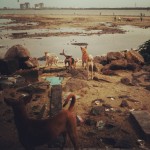
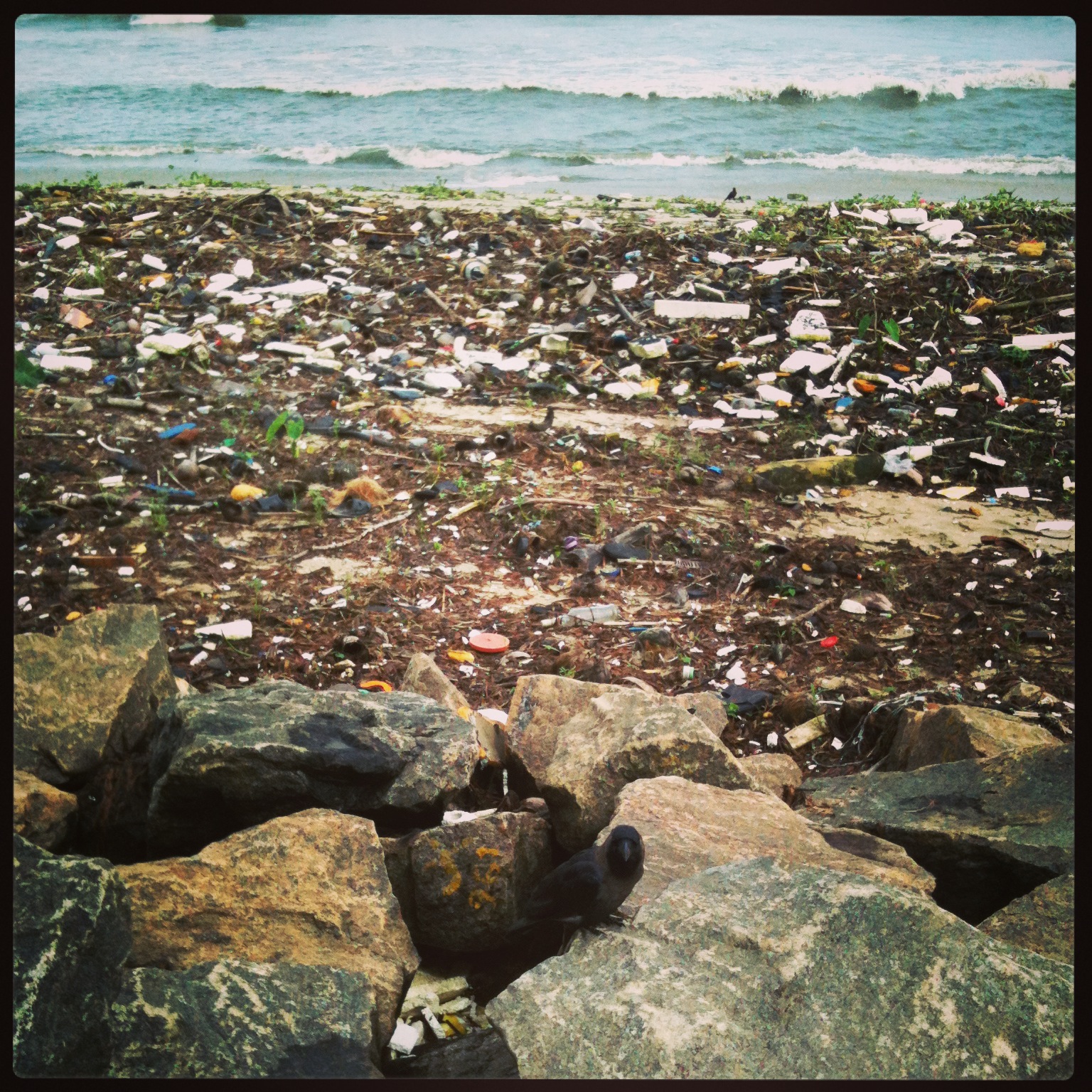
Inventory of items on Kochi Beach

Kochi, formerly Cochin, was my first stop in India. I arrived late and woke to unexpected quiet. Preconceptions of bustling, burly India were subverted by a solar-panel corruption strike. Wandering the empty backstreets I ended up on a nearly deserted beach. It was covered in all sorts of fascinating objects, so I started an inventory.

Cochin beach

Incandescent light bulbs, unbroken: 3
Single thongs in various states of disrepair: 57
Plant matter (kg est): 988
Roma tomatoes, firm but ripe: 0.5
Red onion: 1
Goat carcass: 1
Glass bottles with lids: 14
Glass bottles without lids: 38
Plastic bottles: 21
Messages in bottles: 0
Boys teaching pet dogs to swim: 14
White Labradors resisting swimming lessons: 2
Coconut hulls: 67
Spent WD40 cans: 1
Petrol cans, with lids: 9
Miscellaneous lids: 72
Empty laundry liquid packet: 1
Plastic laundry basket, unbroken: 1
Unidentifiable plastic particles: 6,347
Styrofoam, assorted chunks: 5,217
Lolly wrappers: 245
Funeral sari: 1
Colombo crows: 7
Oversized seagulls: 19
Spare rickshaw parts, rusted: 33
Scooter seat cover, some water damage: 1

Posted in Uncategorized | Leave a comment

Open Table

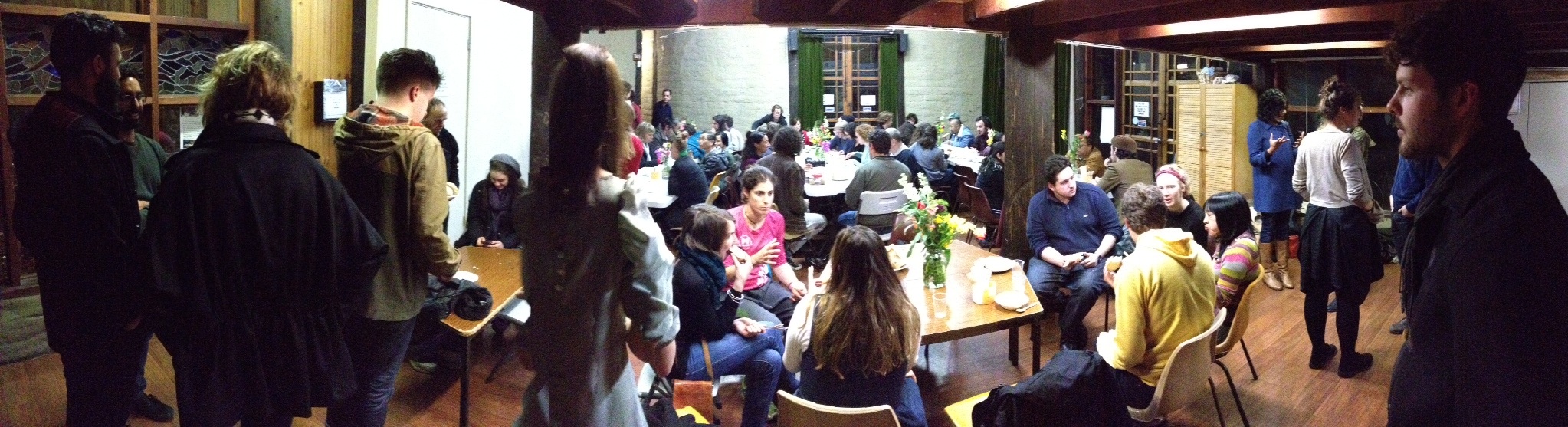
Dinner is served at Open Table #8. Thanks Anthony.

Back in February Georgia and I were drinking wine on the verandah. We had both just arrived back in Melbourne, and were comparing travel stories and bank balances. She was starting to freelance as a designer and I was still looking for the right PhD; we were both staring down the barrel of fairly grim financial futures. Somewhere in-between the third and fourth glasses, and cabbages and kings, we got onto Soppa för Värme. Linking food waste streams with hungry mouths makes so much sense we naively agreed that we would replicate it in Melbourne.

Two broke sheilas with limited experience in food or community engagement. We called in some friends and started planning. Our vision needed surplus food, a welcoming venue, and local marginalised people. We started talking to council, local assisted housing residents, visiting possible sites, liaising with food organisations and ducking out for clandestine late night poster missions. And somehow we managed to create the organic, beautiful, accessible Open Table.

During the four months I was involved I had many beautiful experiences: from making firm friends with people I wouldn’t ordinarily feel comfortable chatting to, witnessing the love and energy that complete strangers poured into the project, and the way that the vision bought our motley band together. Every moment was uplifting.

The response was wonderful, you can read about our latest successes here (my favourite is being named as ‘one of the ‘hottest restaurants to eat in right now’ alongside Movida.) There is every reason to believe that Open Table will continue to share food and grow community spirit.

This is not a story about how much food goes to waste, or how important inclusive community is, or that many hands make light work. Even though these things are true. For me, this is a story about not waiting until you have a stable job, house, income; not waiting for the perfect moment. This is a story about diving in and doing something that you believe in. Carpe that Diem.


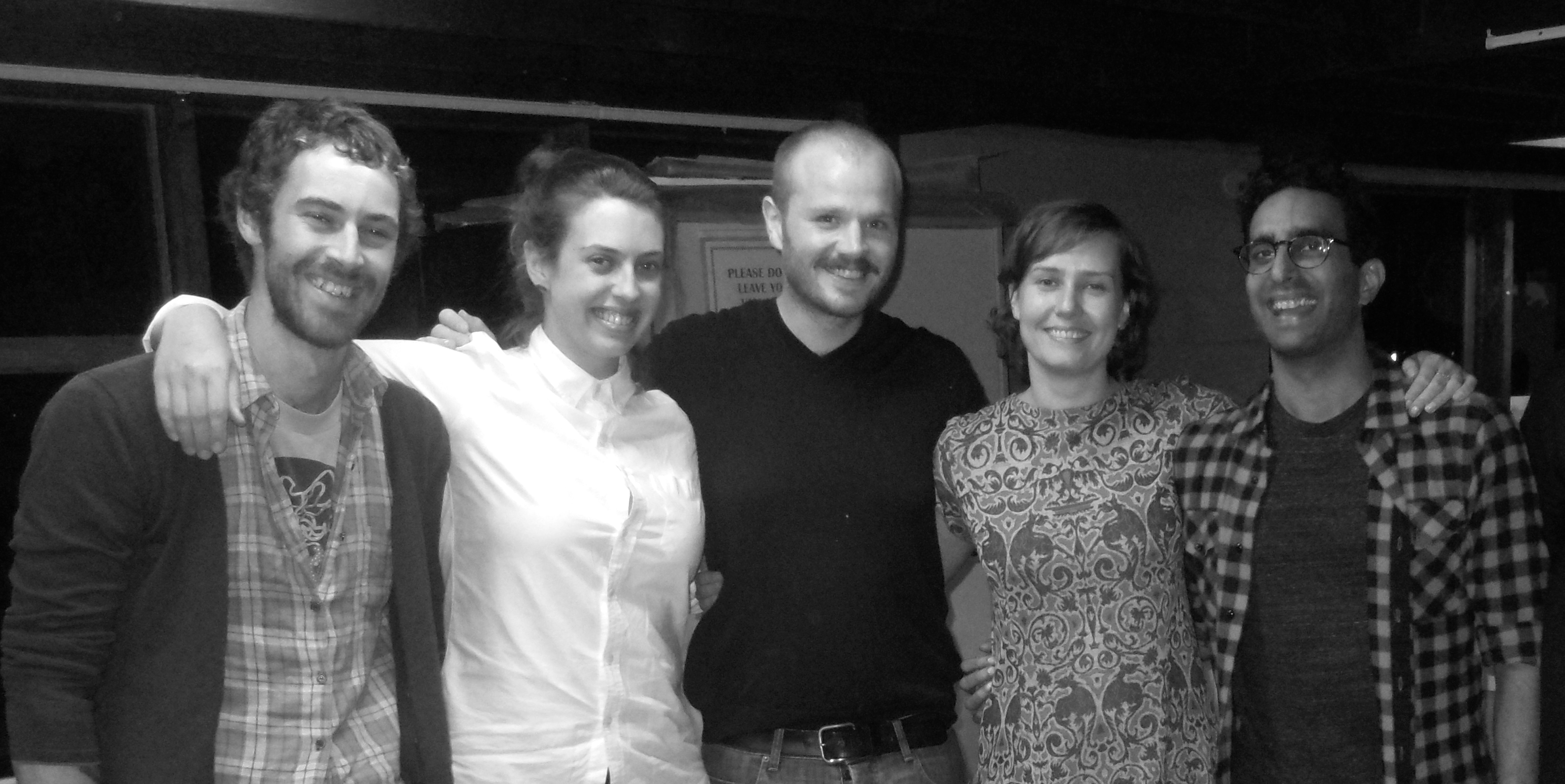
The gang: Liam, Georgia, Anthony, me and Viv. Thanks Viv's parents.

The gang: Liam, Georgia, Anthony, me and Viv. Thanks Viv’s parents.


Posted in Uncategorized | Tagged , , , , , , , , , , , , , | Leave a comment

The dirt on clothes: why washing less is more sustainable

The Conversation


I wrote a piece for The Conversation recently, about my MPhil jeans research. It was really interesting to fit my 45,000 word thesis into 800 words (the editors are strict!). The article had a great response: over 300 shares on facebook, 50 tweets and 30 comments – I love hearing about how different people make sense of this work, some of my favourite comments below.

Julie Leslie “I have to admit I enjoy freshly cleaned and sun warmed-clothes. I think I would rather go with out the tele than not be able to wash my clothes.

Lydia Isokangas “Making necessary changes that benefit the environment seem far too hard to implement for the individual e.g. cycling instead of driving, installing solar panels etc. Sooner or later it impacts on our accustomed lifestyles and everyone has something that’s very difficult to give up. On the other hand, I guess that for many of us, doing less washing, drying and ironing would be a blessing and could be some very low hanging fruit that we could encourage our friends and family to adopt as well. Plus it saves money and time!

William Hollingsworth “Lets get real, the western world from my experience has a totally self destructive ethos when it comes to cleaning. Nature is self cleaning. We weren’t born with showers (very bad for washing our natural oils away and the detergents used for washing should be left for washing machinery).We build no immunity in a sterile or perceived clean world. Washing has become an aesthetic not scientific exercise.

You can read the entire article (and comments) on The Conversation.


Posted in my work, Uncategorized | Tagged , , , , , , , , | Leave a comment

Summer Essay

The stars are getting higher and harder, the air more acrid at the back of my throat and the flame tree fringes are starting to flash amber: Autumn is finally coming after the longest, most glorious Summer I have ever spent in Melbourne.

After the intensity of my thesis, and subsequent writing and conferencing, this Summer has been all about getting out of my mind and immersing in the physical and social world. I started working as a postie delivering mail everyday, lived in a beautiful mansion with 7 of the coolest people I know, started Open Table with my friends, hosted couch surfers, gone to yoga so much my teacher calls me rubber back and have not read a single academic book or paper.

During this time I have been writing short bursts in my diary, and in the tradition of Mary Schminch, I’m eschewing fears of being a self-indulgent twat and sharing them… Starting from… now:

• Enjoy life as a series of beautiful moments.

• Tell your friends that you love them as often as you can.

• Tell bad jokes frequently. Try and remember the punch-line before launching in. If you can’t remember the punch line laugh anyway.

• Remember that you are going to die one day. Live like that day is tomorrow.

• Don’t be cavalier with traffic. Bike vs Car scuffles have predictable casualties.

• Wear brightly coloured socks. It will make your colleagues smile.

• Look at people in the eyes. Ask questions. Listen. Really understanding someone is a deeply satisfying human experience.

• Caring about status is a colossal waste of time: people who you think you are too cool for may be the ones who open your mind the most; people who you think are too cool for you may actually really want to spend time with you.

• Don’t waste time curating photos of yourself on facebook. The popular girls from high school are too busy constructing heir own digital farces to care about yours.

• Sleep with your phone on flight-mode.

• Call in sick and go to the beach when the weather is good.

• Make jam. Label the burnt batches ‘caramelised’. Give the good batches to your neighbours.

• Write your neighbours letters. Try not to get issued with restraining orders.

• People get sick. People die. People will tell you they have cancer via facebook. This will be horrible, but at least you are now pre-warned.

• Cook for your housemates when they least expect it. Clean up at least 10% more mess than you made.

• Read poetry.

• Sing out loud while riding your bike. By the time people realise what you are doing, you will be too far away to see their reactions.

• Kiss like you are in love. Fall in love. Enjoy every beautiful moment. Always say good-bye, like it is the last time that you will ever see your lover.

• Things never turn out how you imagine, but what ever happens somehow manages to be exactly right for you, right now. Don’t waste time cursing serendipity.

• Don’t waste time dismissing everything that ever came from religion. Intelligent people worked for centuries on religious texts, they can be a useful short cut to living a good life.

• Think about what living a good life means for you. Experiment with the contribution you can make to the world.

• Watching Beyoncé videos is a valid contribution. So is ‘dancing’ along.

• Email people that you admire. Tell them why. Beyoncé writes back to fan mail.

• Keep your possessions to a minimum. Things only slow you down.

• Practice non-violence. Be vegetarian.

• Throw wild vegetarian dinner parties on Tuesday nights.

• Drink wine on the veranda.

• Text your parents at 3am to tell them that you love them. They probably already think you have a few screws loose.

• Have a chat with the homeless lady outside Aldi. Do not give her beer in a glass bottle.

• Shave your head at least once in your lifetime. Know that you probably won’t look as good as Natalie Portman. But at least you tried.

• Remember that you are not morally superior to anyone. Even if you are vegetarian and look like Natalie Portman with a shaved head. Humility is so hot right now. And always.

• See things from as many perspectives as you can. Make friends with people who have different backgrounds to you. They see the world in interesting and different ways.

• Host couch surfers.

• ‘Them’ is an illusion. There is only ‘Us’. The more strangers you meet, the more you know this to be true.

• Know that helping others is the only way to be happy.

• Never pretend to have the answers. Even if you do, life is much more fun lived in experimentation.


Thank you for indulging these brain blurts, I loved every minute of writing. Like Mary Schminch I absolutely encourage everyone to try writing a personal essay. It is a brilliant way to spend a Sunday morning.

Predictably I’m off to India to practice Ashtanga Yoga. I am still unsure about what my future holds after that. I know that my PhD is lurking there somewhere and I am nearly ready to embrace it with my newly flexible arms.

Posted in Uncategorized | Tagged , , , , , , , , , | Leave a comment

Avoiding generalisations: theory is dead

Is thinking about the world in abstract, generalised terms useful? What is the point of spending years arguing over nuanced and sophisticated understanding of society? Does applied theory exist? To make theory ‘work’ do you have to add too many factors, caveats and contextual consideration to actually be generalised? Does anyone, even elite professors, really understand theory? Is ‘understanding’ theory valuable?

Posted in Uncategorized | Tagged , | 1 Comment