
In Sweden, almost half of all households are single-person households. That comes at a cost.
People living alone spend a large share of their income on housing — in rental accommodation, often more than those with families. Two adults sharing a home also share the bills: broadband, home insurance, streaming services. Housing — the single biggest expense — can be split in half. Are your housing costs too high? Try moving in with someone. It’s not about romance. It’s about mathematics.
You don’t need to be in love to move in together. Several people choosing to share a home — whether they already know each other or are strangers — is nothing new, but today, when so many of us live alone, share-housing is relevant in a new way. Two best friends can share a two-bedroom flat. A recently divorced 50-year-old can rent out their spare room to a student. Three pensioners can sell their small flats and buy a larger home together.
I recently completed a research project on solo living and published the study Home Alone: solo living pathways, everyday experiences and policy implications for sharing and sustainability. My research shows that most people who live alone did not choose it as their first preference — it came about due to various circumstances. It might be moving to a new city for a job, going through a divorce, or children leaving home. Many of the people I interviewed said they could imagine living with someone again, if the right opportunity came along.
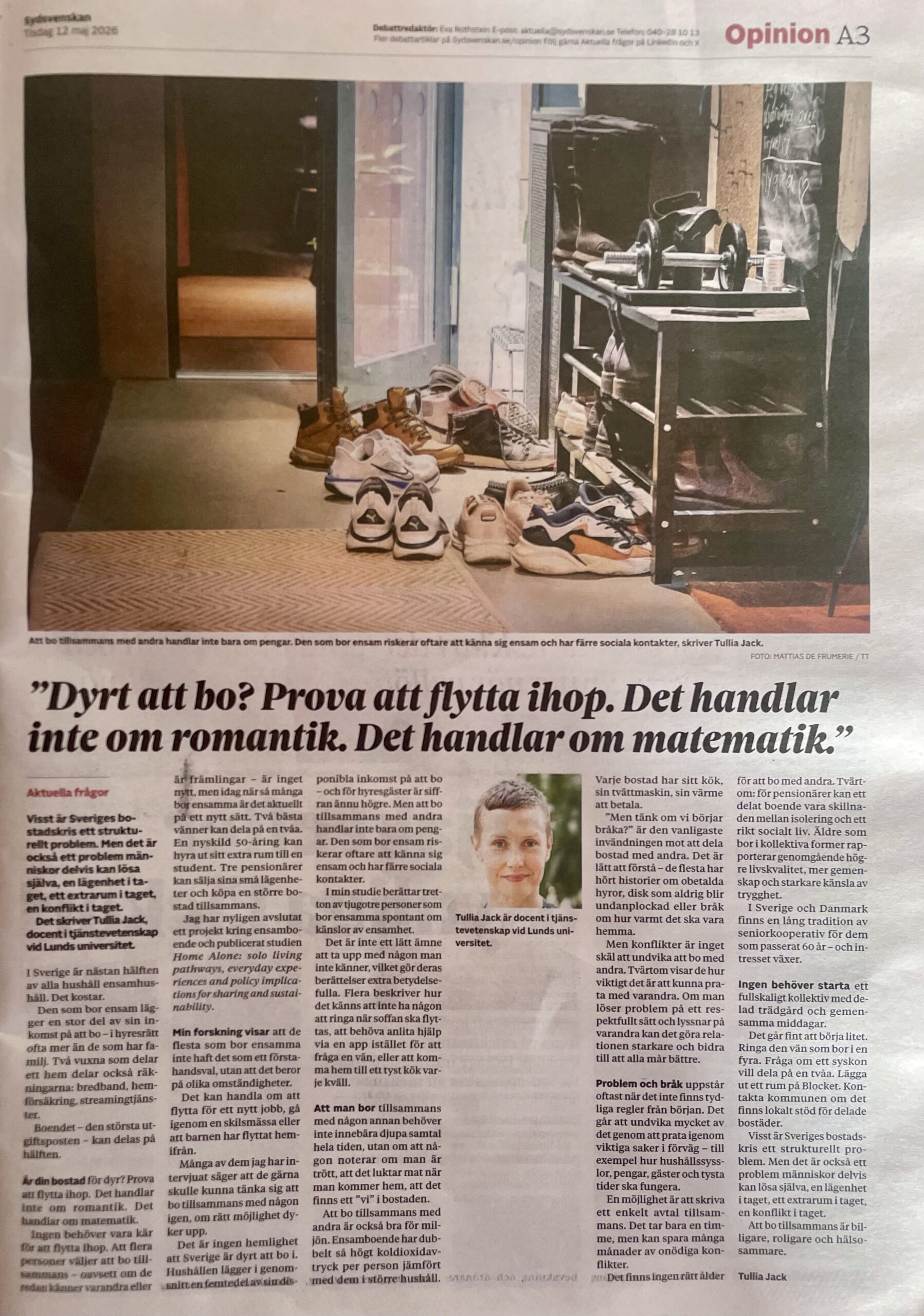
It’s no secret that Sweden is an expensive place to live. Households spend on average a fifth of their disposable income on housing — and for renters, the figure is even higher. But living with others isn’t just about money. People living alone are more often at risk of loneliness and have fewer social connections.
In my study, thirteen out of twenty-three people living alone spontaneously brought up feelings of loneliness. It’s not an easy topic to raise with someone you’ve just met, which makes their accounts all the more significant. Several describe what it feels like to have no one to call when the sofa needs moving, to have to hire help through an app instead of asking a friend, or to come home to a quiet kitchen every evening. Sharing a home with someone else doesn’t have to mean deep conversations all the time — it’s about someone noticing when you’re tired, the smell of food when you walk in the door, having a “we” in your home.
Living with others is also better for the environment. People living alone have twice the per-person carbon footprint of those in larger households. Every household has its own kitchen, its own washing machine, its own heating bill to pay.
“But what if we start arguing?” is the most common objection to sharing a home. It’s easy to understand — most people have heard stories about unpaid rent, dishes that never get washed, or conflicts about the aircon. But conflict is no reason to avoid living with others. On the contrary, it shows how important it is to be able to talk to each other. Resolving problems respectfully and listening to one another can actually strengthen the relationship and contribute to everyone’s wellbeing.
Problems and arguments most often arise when there are no clear ground rules from the start. A great deal of that can be avoided by talking through the important things in advance — for example, how household chores, money, guests and quiet hours will work. One option is to draw up a simple written agreement together. It only takes an hour, but can save months of unnecessary conflict.
There is no right age for living with others. On the contrary: for pensioners, a shared home can be the difference between isolation and a rich social life. Older people living in collective arrangements consistently report higher quality of life, more companionship and a stronger sense of security. In Sweden and Denmark there is a long tradition of senior co-housing for those who have passed 60 — and interest is growing.
Nobody needs to start a full-scale commune with a shared garden and communal dinners. It’s perfectly fine to start small. Call your friend who lives in a four-room apartment. Ask a sibling if they want to go halves in a cottage. Put a room up on GumTree. Contact your local council to find out what local support is available for shared housing arrangements.
Sweden’s housing crisis is certainly a structural problem. But it is also a problem that people can partly solve themselves — one flat at a time, one spare room at a time, one conflict at a time.
Living together is cheaper, more fun, and healthier.