
Women outnumber men in academia — until they don’t.
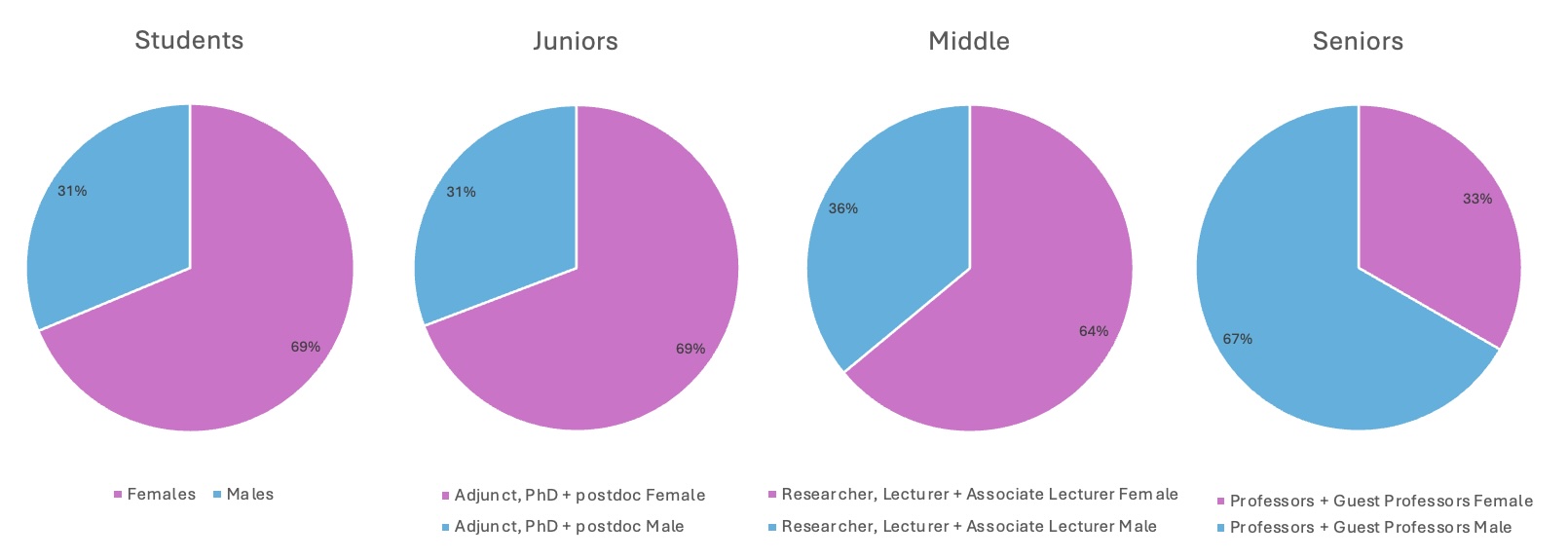
I made this graph for a presentation at our Monday meeting December 2025.
Last year a senior colleague asked if I could teach on a course with them. I said I couldn’t since I was finishing up a project.
Their response: “Oh, how nice — do you have a rich husband?”
In 2025. At a Nordic university. From a colleague who describes themself as a feminist.
This, friends, is bias. Not dramatic, not malicious, but structurally deep: not seeing a woman’s achievement as her own. It turns out there is a name for the belief that women don’t really belong in research -the silent standpoint.
The silent standpoint is a widespread but un-articulated belief that women are less qualified for the top academic positions. Too taboo to say out loud. But present, structurally, in how colleagues are evaluated, recruited, and imagined. My colleague Emma Lundin added that one of her “core annoyances in Sweden is the much-held belief that gender equality was achieved at some point in the recent past, and that structural inequality as a consequence doesn’t exist.” Except that it does, if you look at the leaking pipe graph above.
The authors of the silent standpoint, Järvinen and Mik-Meyer are both female professors at Danish Universities where women constitute only 26% of full professors in the social sciences. They interviewed 77 Danish professors in the social science (46 men and 31 women) and found remarkable differences in the explanations of men and women on gender imbalance of professors.
Women pointed to the university itself: male networks that advance careers, evaluation criteria that favour a narrow definition of research excellence, an unequal distribution of service and administrative work that drains women’s research time, and a culture where women are, as one interviewee put it, allowed — but not truly welcome.
Men pointed elsewhere. To family. To women’s choices. To women’s lack of competitive drive (p.7). Only about one in five male professors mentioned any structural or institutional factor — compared to 97% of women. And half of the male professors hesitated significantly or refused to answer at all.
Some of the consequences of the silent standpoint (random selection from my personal experience):
- Bachelor and Masters thesis students not taking feedback seriously.
- Visiting researchers asking for all male colleagues emails planning “to do something together” and not asking for mine.
- Male colleagues adding each other to their grant applications.
If my n=1 experience is widespread this is a huge potential loss for knowledge production. And since mixed-gender research teams produce more novel and higher-impact discoveries (Yang et al., 2022), women in political leadership significantly reduce greenhouse gas emissions (Mavisakalyan & Tarverdi, 2019; Salamon, 2022), the silent standpoint isn’t just an obstacle for women in academia. It’s an obstacle for the kind of knowledge production the world urgently needs.
The response from Nordic academia has mostly been to fix the women. Mentoring schemes. Confidence workshops. Strategies for developing female talent.
But the intervention model isn’t working — because the problem is not women.
The problem is in the structures: who gets into networks, how excellence is defined, who absorbs the invisible service work, whose research is treated as “hardcore scientific thinking” (Järvinen & Mik-Meyer, 2026, p.9 (this is now my LinkedIn tagline)). These ideas are not neutral. They encode bias about what research is — and those assumptions have consequences some of which you can see in the above graphs and my n=1 experience, but many of which we don’t see, can barely think about and don’t have the vocabulary to speak about.
Thanks Järvinen & Mik-Meyer for giving us a new language to deal with this old problem.
Reference List
Järvinen, M., & Mik‐Meyer, N. (2026). The Silent Standpoint: How Professors Explain Gender Disparities in Academia. The British Journal of Sociology. https://doi.org/10.1111/1468-4446.70095
Mavisakalyan, A., & Tarverdi, Y. (2019). Gender and climate change: Do female parliamentarians make a difference? European Journal of Political Economy, 56, 151–164. https://doi.org/10.1016/j.ejpoleco.2018.08.001
Salamon, H. (2022). The effect of women’s parliamentary participation on renewable energy policy outcomes. European Journal of Political Research, 62(1), 174–196. https://doi.org/10.1111/1475-6765.12539
Yang, Y., Tian, T. Y., Woodruff, T. K., Jones, B. F., & Uzzi, B. (2022). Gender-diverse teams produce more novel and higher-impact scientific ideas. Proceedings of the National Academy of Sciences, 119(36), e2200841119. https://doi.org/10.1073/pnas.2200841119
Thanks for sharing your personal observations.
Many of us men are blind to the invisible advantage (a.k.a. privilege) we have, just because we look the same as the bosses usually do, and share the same lingo.
I am glad there are more people of all backgrounds, colours and flavours in academia nowadays, compared to the 1900s, when I was a student.
Looking back a generation at a time, the pies would have looked different, I guess.
When my mom started engineering grad school in the 1960s, they were something like 2% females in the total student body and even less in research staff and leadership positions.
I suspect that the last pie will flip a half generation from now, with a subsequent loss of status, salary and prestige of the academic professorship position, as has already happened to dentists and teachers in Scandinavia.
On the other hand, the work atmosphere in academia will probably open up and become more innovative and lateral-thinking, warm and welcoming. More people will collaborate in new ways. Most of the best bosses I had were women (Ingrid Udén Mogensen, Eva Karlsson, Emma Wikström et al.), who inspired and led instead of managed the crew.
Peace,
Göran